

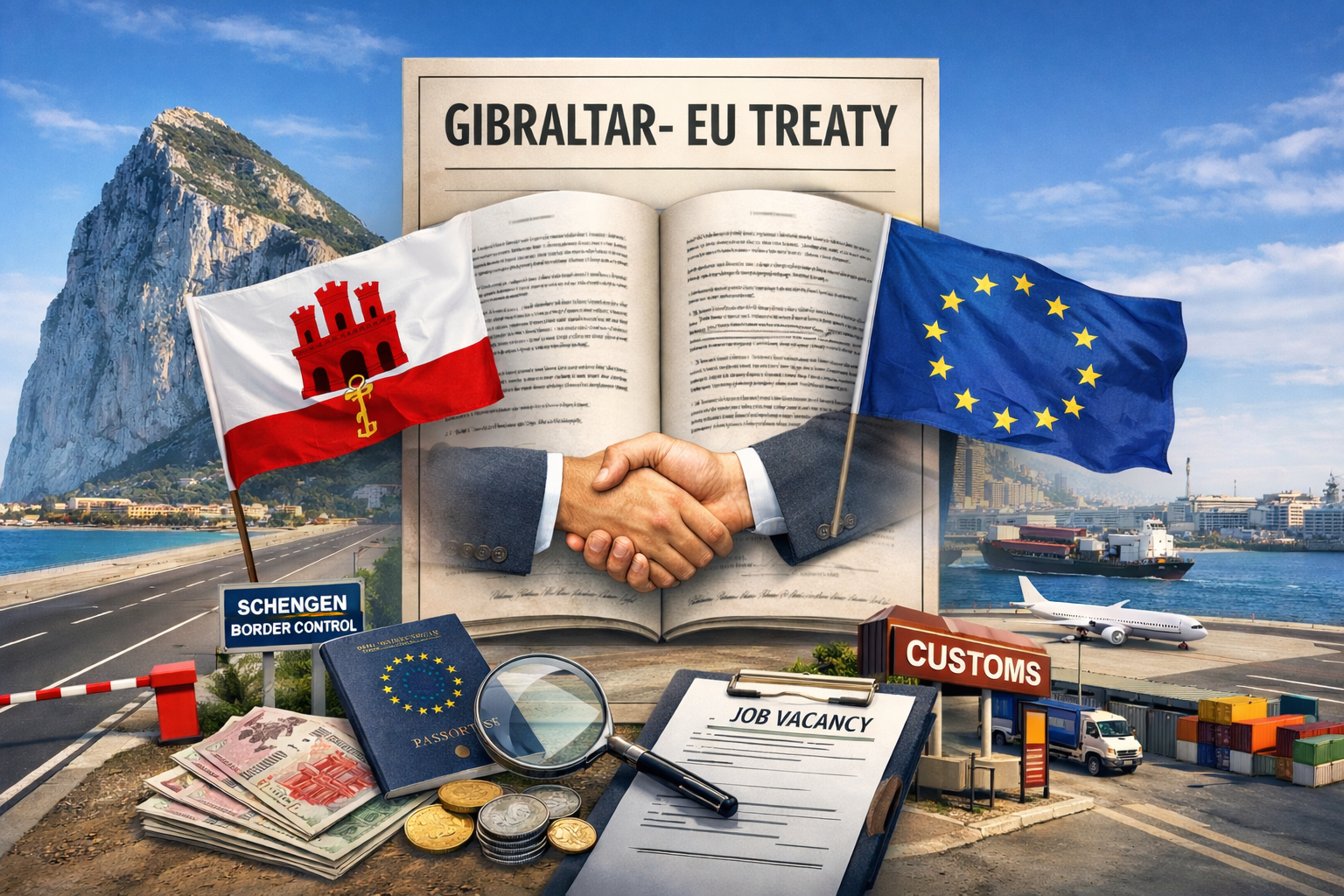
Gibraltar is small, politically complicated, and economically allergic to uncertainty. So when a treaty draft drops that’s 1,000+ pages long, most people don’t want a law lecture - they want the punchline: will life get easier, will it stay safe, and will the local economy (plus the Campo) benefit?
Based on the text released, the draft tries to do three big things at once: remove physical barriers for people at the land border, create a structured system for airport/port border checks, and set up a customs/trade framework that protects the EU Single Market while keeping Gibraltar trading.
"Remove physical barriers" doesn’t mean "remove controls". The draft is basically: fewer bottlenecks at the land frontier, but clearer checks where they belong (airport/port), plus rules that stop the whole thing turning into a loophole-festival.
The draft’s intent is blunt: physical barriers related to the circulation of persons between Gibraltar and the Schengen area should be removed - while "preserving the integrity of the Schengen area" through controls, measures, and safeguards.
It even spells out "removal of physical barriers" as a concrete principle. That’s the bit that matters to normal life: commuters, family visits, appointments, deliveries, and the general stress level of the frontier.
But the draft also makes it clear that entry conditions are cumulative (Gibraltar checks and Spain/Schengen checks), and that Gibraltar undertakes to align its entry conditions to those applicable under Union law. Translation: smoother doesn’t mean softer - it means more structured.
One of the smartest (and most emotionally loaded) parts of the draft is how it handles the airport and port. It says border crossing points are to be set up at the airport and port, and that all passengers entering via port/airport are subject to border checks.
It also sets out a two-step sequencing for checks: on entry, Gibraltar authorities first and then Spain; on exit, Spain first and then Gibraltar. That’s a "belt and braces" approach - and it’s designed to reassure both sides that nobody is hand-waving security.
Another detail that matters: the draft states Gibraltar authorities would have no access to EU information systems/databases established under Union law. That’s the kind of line you include when you’re trying to avoid mission-creep and keep responsibilities separated.
The draft contains an entire section on frontier workers - who they are, and what rights attach. It defines employed frontier workers (and self-employed) using the common-sense idea: work on one side, return at least weekly to the other.
More importantly, it gives frontier workers rights and equal treatment provisions (non-discrimination on nationality in employment, remuneration, conditions of work, plus certain social and tax advantages - with some specific carve-outs).
Why does that matter for Gibraltar and the Campo? Because the frontier workforce isn’t a "nice-to-have" - it’s a structural component of the local economy. Clear rules reduce fear, reduce paperwork chaos, and make hiring decisions easier on both sides.
The preamble is unusually direct about the objective: removing physical barriers to the movement of goods by land, while protecting the integrity of the EU Single Market and financial interests - including fighting customs fraud and tax fraud, and applying relevant product/market rules.
Then it gets very "nuts and bolts": under the customs arrangements, the draft authorises the Union to carry out customs clearance formalities on behalf of Gibraltar’s competent authorities for certain processes - in accordance with Union customs provisions - via designated customs posts.
It also lists designated customs posts in Spain (e.g. La Línea, Algeciras, Sagunto in Valencia) for parts of the process. The vibe is clear: trade flows should be smoother, but enforcement is meant to be robust and auditable.
Based on the draft text: it’s aiming to be good in the way grown-up agreements are good - not through magic, but through predictability.
The honest caveat: implementation details and real-world operations are where treaties either shine or become a bureaucratic soap opera. This is still a draft "subject to legal review", and politics can always throw a banana peel onto the track. But the structure here is recognisably designed to lower friction without lowering standards.
Browse the latest jobs in Gibraltar and set up alerts for roles that match your skills.
Hiring in Gibraltar? Post a vacancy on GibraltarJobs.ai and reach candidates who actually want to work here.
© 2026 GibraltarJobs.ai